Golf carts were originally designed to carry players and their equipment around a golf course. Today, these compact vehicles are also used in resorts, residential communities, warehouses, airports, parks, farms, factories, and large private properties.
Modern golf carts are available with different powertrains, seating arrangements, suspension systems, and body configurations. Some are simple two-seat vehicles intended only for golf courses, while others can transport six or more passengers, carry tools, or operate legally on certain public roads.
Choosing the right model depends on where the cart will be driven, how many people or how much cargo it must carry, and whether it needs to meet local road-use requirements.
Traditional Golf Course Carts
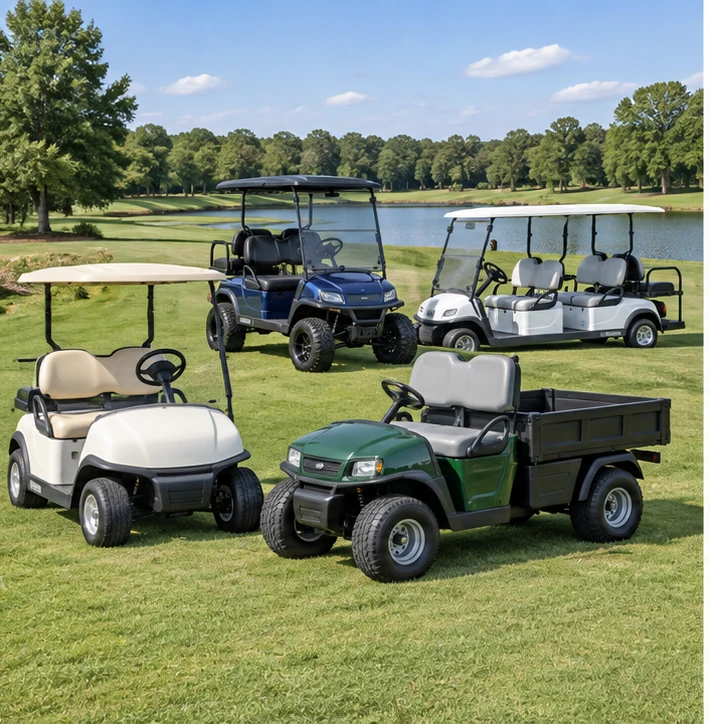
A traditional golf cart normally has two seats, space for two golf bags, a roof, and relatively simple controls. It is designed for short trips at low speeds on maintained golf-course paths.
Golf-course models prioritize ease of use, quiet operation, and minimal damage to the grass. Many courses use electric fleets because electric carts are quiet and do not produce exhaust while operating. Gas-powered models are also available and may be preferred where vehicles cover longer distances or cannot be charged easily.
Fleet carts are usually less customized than privately owned vehicles. They may have basic seats, small tires, and limited storage beyond the golf-bag area. Course operators often choose large groups of identical carts so maintenance, charging, and replacement parts can be managed more efficiently.
Electric Golf Carts
Electric golf carts use rechargeable battery packs to power an electric motor. Traditional models frequently use lead-acid batteries, while an increasing number of newer carts are available with lithium-ion battery systems.
Electric carts are quiet, smooth, and easy to operate. They do not require engine oil changes or gasoline, and they usually have fewer moving drivetrain components than gas-powered models. This makes them popular for golf courses, resorts, residential neighborhoods, and indoor or partially enclosed facilities.
The main limitation is charging. Range depends on battery type, capacity, terrain, passenger weight, speed, temperature, and vehicle condition. A cart used on steep hills or carrying several passengers will normally consume more energy than one driven on level ground.
Lead-acid batteries require regular inspection and proper charging. Some designs also require owners to monitor electrolyte levels. Lithium systems are generally lighter, charge faster, and require less routine battery maintenance, but their purchase and replacement costs may be higher.
Gas-Powered Golf Carts
Gas golf carts use a small internal-combustion engine. They can be refueled quickly and are useful where the vehicle must operate for long periods without access to a charging point.
These carts are often selected for farms, large properties, construction sites, and commercial facilities. A gas model may also perform well when carrying loads or traveling through hilly areas, although capability depends on the engine, gearing, tires, and vehicle design.
The tradeoff is additional maintenance. Gas-powered carts require fuel, engine oil, filters, and other service items. They are also louder than electric carts and produce exhaust emissions during operation.
Gas carts should not be operated in enclosed or poorly ventilated spaces. Carbon monoxide is dangerous and may accumulate even when the vehicle’s engine is relatively small.
Passenger Golf Carts
Passenger models are designed to transport more people than a traditional two-seat golf cart. Common configurations include four- and six-passenger vehicles, although larger shuttle-style models are also available.
A four-passenger cart may use two forward-facing rows or a front bench with a rear-facing seat. Some rear seats can fold down to create a small cargo platform. Six-passenger models are longer and require more room for turning and parking.
These carts are widely used at resorts, hotels, campuses, event venues, and residential communities. Manufacturers such as E-Z-GO offer two-, four-, and six-passenger models with electric or gas powertrains, illustrating how broad this category has become.
Passenger capacity should never be increased using unapproved seats or homemade modifications. Additional passengers change the cart’s weight distribution, braking distance, and rollover risk.
Utility Golf Carts
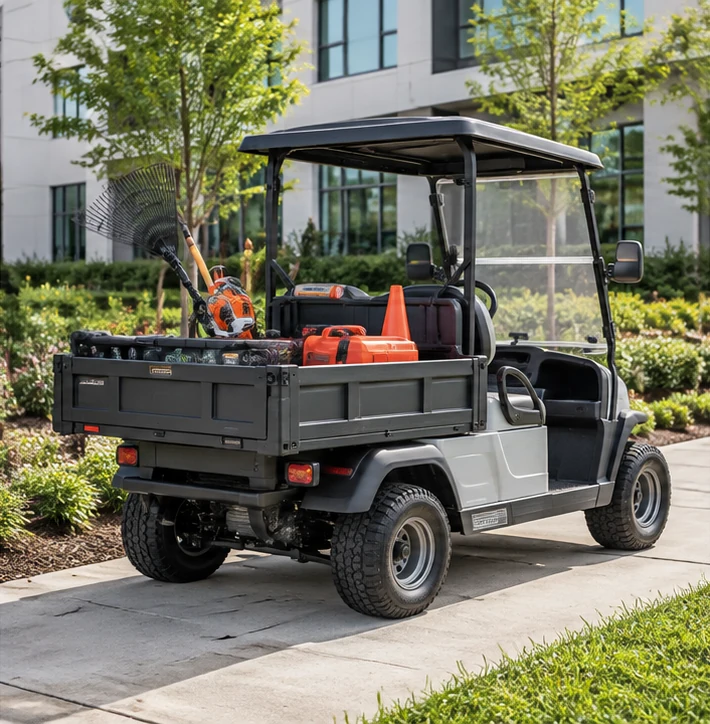
Utility carts replace some or all passenger seating with a cargo bed, tool storage, or specialized equipment. They are commonly used by maintenance teams, grounds crews, farmers, warehouse employees, and property managers.
Light-duty utility models may carry small tools, landscaping materials, or supplies. Heavier vehicles can be equipped with larger cargo boxes, towing equipment, enclosed cabs, or attachments designed for a particular job.
Payload and towing capacity vary significantly. The fact that a load physically fits in the bed does not mean the vehicle can carry it safely. Owners should follow the manufacturer’s weight limits and distribute cargo properly.
A utility cart used for work may need stronger suspension, all-terrain tires, weather protection, lights, mirrors, or a more durable body than a recreational model.
Lifted and Off-Road Golf Carts
A lifted golf cart has increased ground clearance, larger tires, and suspension modifications. These models are popular for recreational use and can handle some trails, uneven ground, and loose surfaces better than standard course carts.
However, a lift kit also raises the vehicle’s center of gravity. This can reduce stability during sharp turns, on side slopes, or at higher speeds. Steering, braking, alignment, and suspension geometry may also change.
An off-road appearance does not automatically make a cart suitable for extreme terrain. Standard golf carts generally do not provide the same structure, suspension travel, occupant protection, or performance as purpose-built utility terrain vehicles.
Buyers should select professionally engineered components designed for their exact model. Tires must have appropriate clearance, and the suspension, steering, and brakes should be inspected after modification.
Street-Legal Golf Carts and Low-Speed Vehicles
A golf cart and a federally recognized low-speed vehicle are not necessarily the same thing. In the United States, the National Highway Traffic Safety Administration defines an LSV as a four-wheeled motor vehicle, other than a truck, with an attainable speed above 20 mph but not above 25 mph. NHTSA explains this classification in its low-speed vehicle interpretation.
Vehicles manufactured as LSVs must meet applicable federal safety requirements. These can include lighting, mirrors, turn signals, reflectors, seat belts, a windshield, a parking brake, and a vehicle identification number.
Road-use rules are still controlled largely by state and local authorities. A vehicle permitted on one community road may be prohibited in another. Registration, insurance, driver’s-license, equipment, and roadway-speed-limit requirements can differ.
Adding lights and seat belts to a conventional golf cart does not automatically make it a legal LSV. Buyers who plan to use a cart on public roads should check state DMV rules and local ordinances before purchasing or modifying the vehicle.
Commercial and Specialty Golf Carts
Some golf carts are built or modified for specialized tasks. Food-and-beverage carts may include coolers and serving equipment. Security vehicles may use warning lights, storage compartments, or weather enclosures. Medical and hospitality carts can be configured to transport passengers with limited mobility.
Industrial facilities may use compact personnel carriers or burden carriers that resemble golf carts but are designed for more demanding commercial work. Airports, convention centers, and large warehouses may choose electric vehicles because they operate quietly and can be used in appropriate indoor environments.
Specialty equipment adds weight and can change the vehicle’s handling. Installation should follow the manufacturer’s specifications, particularly when electrical systems, passenger restraints, or load-carrying structures are modified.
How to Choose the Right Golf Cart
Begin by deciding where the cart will operate. A basic electric model may be ideal for a golf course or small residential property. A gas or higher-capacity electric model may be more suitable for long daily use. Rough terrain may require stronger suspension and suitable tires, while commercial work may require a utility bed.
Consider the number of passengers, expected cargo, hills, charging access, storage space, weather, and local service availability. Battery replacement cost should be included when comparing electric models, while gas buyers should account for fuel and engine maintenance.
Check whether the cart will remain on private property or travel on public streets. Road use introduces additional legal, registration, insurance, and safety considerations.
Final Thoughts
The main types of golf carts include traditional course carts, electric and gas-powered models, passenger carts, utility vehicles, lifted recreational carts, street-legal LSVs, and specialized commercial vehicles.
There is no single model that is best for every buyer. Electric carts are quiet and convenient, gas models are quick to refuel, passenger carts move groups, and utility models are designed for work.
Choose the vehicle according to its real operating environment rather than appearance alone. Correct capacity, safe equipment, proper maintenance, and compliance with local rules are more important than speed or cosmetic modifications.