Golf may look like a simple sport from the outside, but the equipment used by golfers depends on a surprisingly complex global supply chain.
A driver might be manufactured from titanium components produced in Asia, assembled in Mexico, packaged with a graphite shaft made by another supplier, shipped to a distribution center in the United States, and finally delivered by truck to a golf retailer hundreds of miles away.
Golf balls may come from factories in Massachusetts, Thailand, Taiwan, Vietnam, or other manufacturing centers. Golf shoes and apparel are heavily connected to Asian manufacturing networks, while premium forged irons may have strong links to Japan. Golf bags, gloves, training aids, tees, and other accessories can come from several different countries and suppliers.
This means the answer to “Where does golf equipment come from?” is not one country.
Modern golf equipment is a global product.
Major golf companies manufacture and source products in the United States, Mexico, Japan, China, Taiwan, Vietnam, Thailand, South Korea, the United Kingdom, and other countries. Acushnet, the company behind brands including Titleist and FootJoy, reported that it manufactures and/or sources products principally in the United States, Thailand, Vietnam, Taiwan, China, Japan, and the United Kingdom. Topgolf Callaway Brands has similarly reported golf club manufacturing and assembly operations involving Mexico, the United States, China, Vietnam, Japan, South Korea, Australia, and the United Kingdom.
Getting all of those products to American golfers requires several different types of transportation.
International shipments commonly travel by ocean container, while trucks handle movements between factories, ports, warehouses, distribution centers, stores, and golf courses. Rail can move imported containers long distances across the United States, and air freight may be used when equipment needs to arrive quickly.
Understanding this supply chain explains why a set of golf clubs sold at a store in Ohio or Texas may have already traveled thousands of miles before the golfer ever removes it from the box.
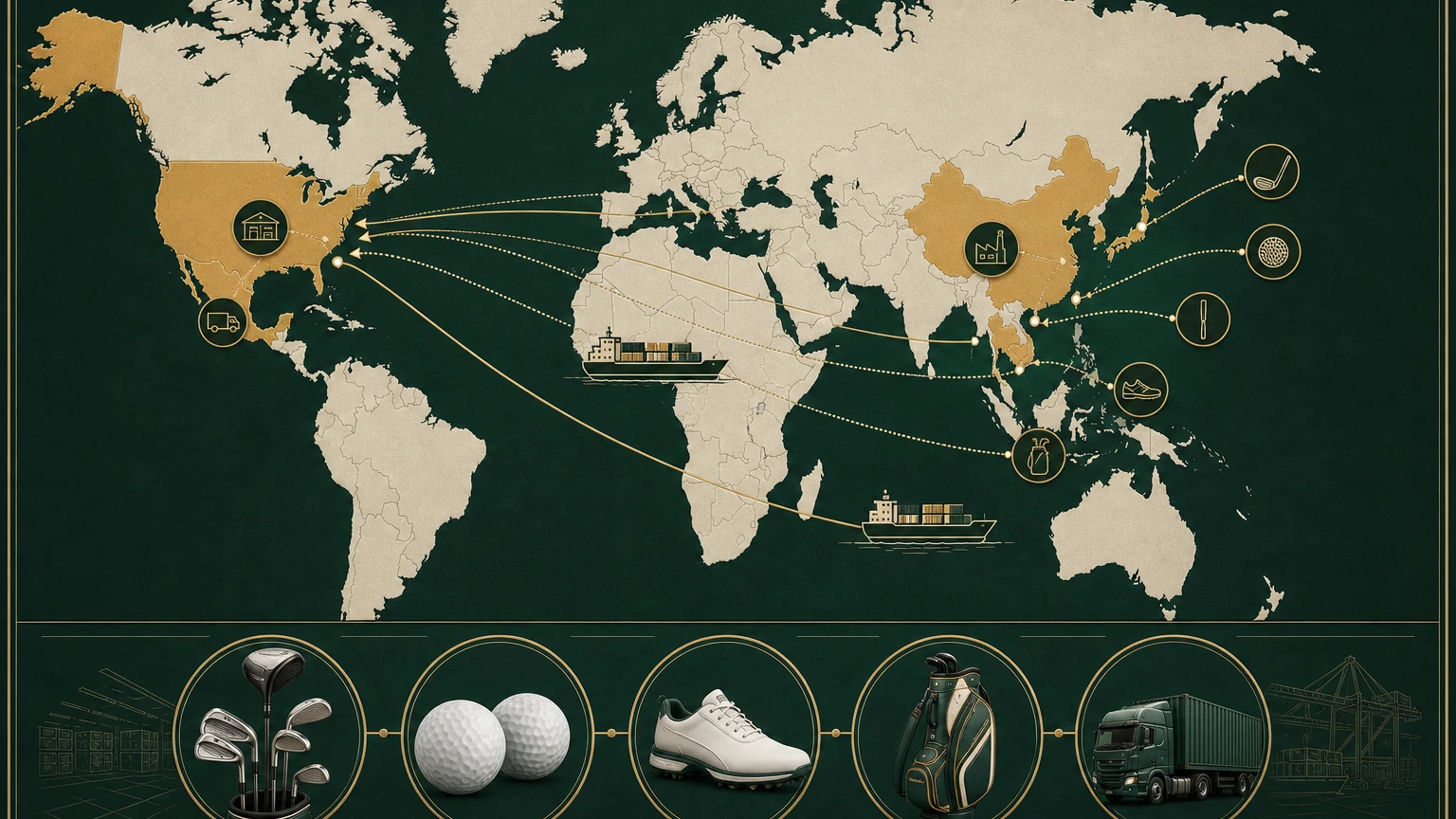
Golf Equipment Is a Global Industry
Golf companies rarely manufacture every component of every product inside one factory.
Instead, the industry uses a mixture of company-owned manufacturing facilities, contract manufacturers, component suppliers, assembly plants, and regional distribution centers.
A golf club provides a good example.
A modern driver can contain a titanium or composite clubhead, graphite shaft, grip, adjustable hosel components, screws, weights, paint, adhesives, and packaging. Those components do not necessarily come from the same supplier or even the same country.
A company may design the club in the United States or Japan while relying on specialized suppliers in Taiwan, Vietnam, or China to produce certain components. Final assembly may then take place in another country.
Callaway provides a useful real-world example of how international the system can become. The company has reported a primary golf club assembly facility in Monterrey, Mexico, a smaller assembly operation in Carlsbad, California, and contract golf-club manufacturers in China and Vietnam. It also operates custom assembly facilities serving markets such as Japan, South Korea, the United Kingdom, and Australia.
Golf equipment suppliers themselves can also have manufacturing footprints spread throughout Asia. One major Taiwanese golf-industry supplier reported that Taiwanese golf equipment companies operate important production bases in Taiwan, China, and Vietnam, serving major international brands through OEM and ODM manufacturing.
This global structure allows golf brands to use specialized factories for different materials and manufacturing processes rather than attempting to produce every item in one location.
Where Are Golf Clubs Made?
Golf clubs are among the most internationally sourced products in the industry.
China has historically been an important manufacturing center because it has a huge network of metalworking, casting, machining, composite, finishing, packaging, and sporting-goods suppliers.
Taiwan is also extremely important to the golf industry. Taiwanese companies have decades of experience producing clubheads, shafts, metal components, and other golf products, with manufacturing operations often spread across Taiwan itself as well as China and Vietnam.
Vietnam has become increasingly important as companies diversify their manufacturing networks. Major golf companies and suppliers now use the country for club manufacturing, components, apparel, footwear, and other products.
Industry filings from golf-component manufacturers identify China, Vietnam, and Taiwan as major locations for global golf club head suppliers.
But saying that a golf club is “made in Asia” can still be misleading because final assembly may happen somewhere else.
For example, a clubhead and shaft could come from Asian suppliers while the finished golf club is assembled and customized in Mexico or the United States.
This is especially common for clubs ordered with custom specifications.
A golfer may select a particular shaft, shaft flex, club length, grip, lie angle, and other specifications. The brand can then assemble the final club closer to its destination market rather than manufacturing every possible configuration in advance.
This reduces the need to keep thousands of finished custom combinations sitting in warehouses.
Why Mexico Is Important for Golf Equipment Sold in the United States
Mexico has a major logistical advantage for companies serving American customers: proximity.
Products manufactured or assembled in Asia normally have to cross the Pacific Ocean before entering the U.S. supply chain.
Products assembled in Mexico can often reach American distribution networks by land.
Callaway's Monterrey operation is a good example. Golf club components can be brought into the assembly facility, completed according to customer or retail requirements, and then transported north toward the United States.
From a transportation perspective, this creates a very different supply chain.
Instead of:
Factory → Port → Container Ship → U.S. Port → Truck/Rail → Warehouse
the route may look more like:
Factory/Assembly Plant in Mexico → Truck → U.S. Border → Distribution Center
Rail can also participate in North American cross-border supply chains, especially for larger freight volumes, but trucking provides the flexibility needed to move shipments directly between assembly operations and distribution facilities.
Mexico is therefore particularly useful for products that benefit from relatively fast replenishment or final customization close to the U.S. market.
Where Are Premium Japanese Golf Clubs Made?
Japan has a special position in golf equipment manufacturing.
Japanese golf brands are particularly well known for forged irons, wedges, precision manufacturing, and products developed for the Japanese domestic market.
Not every Japanese-brand club is completely manufactured in Japan, because many companies use international suppliers just like American brands do.
However, some premium manufacturers continue to maintain substantial manufacturing and supplier networks inside Japan.
Honma Golf, for example, reports retaining key golf club manufacturing processes at its Sakata Campus in Japan. Its 2024/2025 annual report showed that the large majority of its listed golf club suppliers were located in Japan, with smaller groups in Taiwan, mainland China, and other regions.
Mizuno also operates a diversified supply chain. The company states that it manufactures products through both its own factories and outside suppliers, with major supplier locations including Japan, China, Taiwan, Indonesia, Vietnam, Thailand, the Philippines, Myanmar, and Cambodia.
So the label “Japanese golf club” does not always mean every component was produced inside Japan.
The actual country of origin depends on the specific model, component, and manufacturing process.
For buyers interested in where a particular club was manufactured, the country-of-origin marking on the actual product or packaging is more reliable than making assumptions based only on the brand's headquarters.
Where Are Golf Balls Made?
Golf balls have a somewhat different manufacturing network from golf clubs.
The production process requires specialized equipment for forming cores, building multiple layers, molding covers, creating extremely precise dimple patterns, applying coatings, printing logos, and maintaining strict quality standards.
The United States remains an important golf-ball manufacturing country.
Titleist operates golf-ball manufacturing facilities in Massachusetts, and its Pro V1 and Pro V1x products have been manufactured at both its New Bedford, Massachusetts facility and its Thailand facility. Titleist says the same manufacturing and quality processes are used at both locations.
TaylorMade also has a golf-ball manufacturing operation in Liberty, South Carolina, where the company performs production and quality-control activities.
Callaway operates a golf-ball facility in Chicopee, Massachusetts, but its supply chain is also international. Its latest reporting indicates that it uses contract manufacturers in Taiwan, Vietnam, and Thailand, and roughly three-quarters of its golf balls were manufactured outside the United States in 2025.
The important takeaway is that even premium golf balls from major American brands can come from several manufacturing locations.
Country of manufacture depends on the model and brand rather than simply whether the company's headquarters are in the United States.
Thailand Has Become an Important Golf Manufacturing Center
Thailand deserves particular attention because it appears throughout the supply chains of major golf companies.
Titleist produces golf balls there.
Callaway uses contract golf-ball manufacturers in Thailand.
Acushnet's overall product sourcing network includes Thailand, and the company also operates golf-related manufacturing activities there.
Thailand benefits from its position within Southeast Asia and its established manufacturing base for rubber, polymers, textiles, footwear, sporting goods, and related industries.
This makes it well suited to products such as golf balls and gloves, while nearby countries provide additional manufacturing capabilities for clubs, footwear, apparel, and accessories.
For American importers, products manufactured in Thailand usually begin their international journey by truck from the factory to a container terminal, followed by ocean transportation to North America.
Where Are Golf Shoes and Apparel Made?
Golf footwear and clothing have even more in common with the global athletic-apparel industry than with traditional club manufacturing.
Vietnam is one of the most important countries in this part of the supply chain.
Acushnet shifted FootJoy footwear production from China toward a third-party facility in Long An Province, Vietnam, and its current reporting describes a footwear manufacturing partnership in Vietnam.
Topgolf Callaway Brands has also identified Vietnam as an important country of origin for both golf clubs and TravisMathew apparel, while sourcing other products from Taiwan and other countries.
The reason apparel and shoe supply chains are concentrated in countries such as Vietnam is not unique to golf.
The same countries already have extensive networks of factories producing athletic footwear, synthetic fabrics, technical clothing, stitching, molded components, and packaging for international sports brands.
A factory making golf shoes therefore benefits from the same industrial ecosystem used by running shoes, soccer footwear, outdoor clothing, and other performance products.
Indonesia, Cambodia, Bangladesh, China, and other Asian manufacturing centers can also participate in sporting-goods and apparel supply chains.
The exact sourcing country varies by brand and product line.
Where Do Golf Bags, Gloves, and Accessories Come From?
The accessory category is extremely broad.
Golf bags can contain nylon or polyester fabric, molded plastic, aluminum supports, zippers, foam, straps, rain covers, and other components.
Golf gloves may use leather or synthetic materials.
Rangefinders include electronics and optical components.
Push carts use metal frames, plastic components, wheels, and mechanical assemblies.
Tees and practice accessories may use plastic, wood, rubber, textiles, or electronics.
As a result, there is no single sourcing country for golf accessories.
China, Vietnam, Taiwan, Thailand, and other Asian manufacturing countries all participate in these categories.
The sourcing decisions depend on which factories have experience with the materials and manufacturing methods required for the particular product.
A premium leather golf glove and a molded plastic ball retriever do not require the same supply chain, even though both are sold as golf accessories.
That is another reason major golf companies rely on hundreds of suppliers rather than one giant factory producing everything from drivers to golf shoes.
Golf Equipment May Cross Several Borders Before It Is Finished
One of the most interesting parts of the golf industry is that the country where final assembly occurs does not necessarily tell the full supply-chain story.
Consider a hypothetical driver.
The titanium used for the clubhead could originate in one country.
The clubhead could be cast or forged in another.
The graphite shaft might come from a specialist manufacturer in Taiwan or Japan.
The grip could be made at another Asian factory.
The components could then be shipped to Mexico for final assembly.
The finished driver could cross the U.S.-Mexico border by truck and enter an American distribution center.
From there it could be shipped to a retailer in Florida.
Finally, a parcel carrier might deliver it to the golfer's home.
One golf club could therefore involve several suppliers, several countries, and multiple modes of transportation before reaching the player.
This is why major golf companies describe supply-chain coordination as a significant part of their manufacturing operations. Callaway specifically notes that golf club assembly requires raw materials from domestic and international suppliers and substantial global supply-chain coordination.
How Is Golf Equipment Transported From Asia to the United States?
For large commercial shipments, ocean freight is one of the most important transportation methods.
Golf clubs, balls, bags, shoes, apparel, and accessories can be packed into cartons, palletized when appropriate, and loaded into shipping containers.
The container first needs to reach the export port.
That usually requires a truck.
A typical shipment may therefore begin like this:
Factory → Truck → Container Terminal
At the port, the container is loaded onto a container vessel.
Products from China, Taiwan, Vietnam, Thailand, Japan, or South Korea may travel across the Pacific toward U.S. ports.
The exact port depends on the shipping route, origin, destination, carrier, freight rates, available capacity, and the company's distribution strategy.
West Coast gateways can provide relatively direct access from Asia, while importers may also route containers to Gulf or East Coast ports depending on where inventory needs to go.
Container shipping remains fundamental to American imports. U.S. ports were handling millions of TEUs of containerized imports per month in 2026, demonstrating the scale of the broader supply network that sporting goods share with electronics, furniture, clothing, retail merchandise, and other consumer products.
Golf equipment does not normally require refrigerated transportation, which simplifies the process compared with food or pharmaceuticals.
Most golf products can move in standard dry containers as long as they are packaged correctly and protected from moisture, crushing, and other transit damage.
Why Container Ships Are Used for Golf Equipment
Ocean transportation has one overwhelming advantage:
It can move enormous quantities of products at relatively low cost per unit.
Imagine importing 10,000 golf bags or tens of thousands of boxes of golf balls.
Sending that entire shipment by airplane would be extremely expensive.
A container ship can transport large quantities much more economically.
The disadvantage is time.
Ocean freight usually takes much longer than air freight, and the complete lead time includes far more than the number of days the ship spends at sea.
The container has to be booked.
The product must be transported to the port.
The container has to be processed and loaded.
The vessel completes its route.
The container is unloaded in the United States.
Customs procedures have to be completed.
Then the freight still needs inland transportation.
For golf companies planning a major product launch, inventory therefore needs to begin moving well before the clubs appear on store shelves.
This is one reason supply-chain planning is closely connected with product development and sales forecasting.
What Happens When the Container Reaches the United States?
Arrival at the port is not the end of the journey.
In many cases, it is only the beginning of the domestic portion.
Once the container has been discharged from the vessel and cleared for movement, a truck may perform drayage — relatively short-distance container transportation between the port and a warehouse, rail terminal, transload facility, or distribution center.
If the final destination is relatively close to the port, a truck may move the freight directly to a regional warehouse.
If the destination is far inland, rail can become more practical.
For example, an imported container arriving on the West Coast may need to reach a distribution center hundreds or thousands of miles inland.
The container can be transferred to an intermodal train for the long-distance portion of the journey.
Near the destination, another truck picks it up and completes the final movement.
The supply chain then becomes:
Factory → Truck → Port → Container Ship → U.S. Port → Truck → Rail → Truck → Distribution Center
Not every shipment uses every mode.
But combining ocean, rail, and trucking allows importers to balance cost and delivery time.
The Role of Trucks in Golf Equipment Transportation
Even when the product crosses the Pacific on a ship, trucks are involved at almost every stage.
A truck may transport raw materials to a golf factory.
Another truck moves finished products to the export port.
A drayage truck collects the container in the United States.
A tractor-trailer may then transport golf equipment from a port or rail terminal to a national distribution center.
From the distribution center, additional trucks move inventory to regional warehouses, sporting-goods retailers, golf stores, and other customers.
Golf-course pro shops also need regular deliveries of balls, gloves, clothing, shoes, bags, and clubs.
Even e-commerce orders depend on road transportation.
A parcel may spend part of its journey in an airplane, but local trucks and delivery vans still handle pickup, sorting-center transfers, and final delivery.
This makes trucking one of the few transportation modes that appears throughout almost the entire golf equipment supply chain.
Ships can cross oceans.
Trains can move hundreds of containers long distances.
Aircraft can move freight rapidly.
But trucks connect those systems to the actual factories, warehouses, stores, golf courses, and homes.
Full Truckload vs. Less-Than-Truckload Golf Shipments
Once golf products enter domestic distribution, shipment size helps determine the kind of truck transportation used.
A manufacturer or large importer moving a full trailer of golf equipment from a distribution center to a large retailer may use Full Truckload, commonly called FTL.
The trailer is dedicated primarily to that customer's freight.
A smaller shipment may use Less-Than-Truckload, or LTL, service.
In LTL transportation, shipments from several customers share trailer space. Freight passes through terminals where it can be transferred between trailers as it moves toward its destination.
This can make more financial sense when a golf store needs several pallets rather than an entire 53-foot trailer.
For small consumer orders, parcel networks are more appropriate.
A single golf club ordered online does not need a semi-truck dedicated to it.
Instead, the club may be packed in a long shipping box and travel through a parcel carrier's sorting network before arriving at the golfer's home.
The transportation method therefore changes according to shipment size:
Containers for international volume.
FTL for large domestic shipments.
LTL for smaller commercial orders.
Parcel for individual customer shipments.
When Is Air Freight Used for Golf Equipment?
Air freight is much more expensive than ocean transportation, so it generally makes the most sense when speed matters more than transportation cost.
Suppose a company is launching a new driver nationwide and an ocean shipment is delayed.
Waiting several additional weeks could leave stores without inventory during the most important part of the product launch.
The company may choose to send a limited quantity by air to protect the launch while the larger ocean shipment continues normally.
Air freight can also make sense for:
- High-value components
- Urgent replacement inventory
- Samples and prototypes
- Tour or promotional equipment
- Custom products
- Emergency replenishment
- Small high-margin shipments
Golf clubs are relatively lightweight compared with many industrial products, but their long boxes occupy substantial cargo space.
Golf balls are compact but can become heavy in large quantities.
Golf bags occupy significant volume.
That means air transportation can become expensive very quickly when thousands of units are involved.
For normal inventory replenishment, ocean freight is usually more economical.
For emergencies, air freight can solve problems that ocean transportation cannot solve quickly enough.
How Golf Equipment Moves From Mexico to the United States
Golf products manufactured or assembled in Mexico can avoid the trans-Pacific shipping portion of the supply chain.
A truck leaving an assembly plant in northern or central Mexico can travel toward a commercial border crossing and enter the United States after the required customs process.
Depending on the logistics arrangement, Mexican and U.S. carriers may participate in different parts of the movement.
The freight can then travel to American distribution centers using highway or intermodal networks.
For an operation such as golf club assembly in Monterrey, the geography is attractive because major U.S. markets are reachable through established North American freight corridors.
This does not mean every component in the finished club was manufactured in Mexico.
Some parts may first arrive from Asian suppliers.
Mexico can function as the final assembly point, after which the completed product enters the U.S. market.
That is a good example of how modern manufacturing separates component production from final assembly.
How U.S.-Made Golf Equipment Reaches Customers
Not every golf product needs to cross an ocean.
Products manufactured in Massachusetts, South Carolina, California, or other U.S. locations can enter domestic transportation networks directly.
Titleist golf balls produced in Massachusetts, for example, do not need international ocean freight to reach American customers. TaylorMade balls processed through its South Carolina operation also begin much closer to the domestic market.
The route might look like:
Factory → Distribution Center → Retailer
or:
Factory → Distribution Center → Parcel Hub → Customer
Truck transportation handles much of this movement.
Products headed across the country may also enter rail or air networks depending on the shipment and service level.
Domestic manufacturing reduces some international transportation complexity, but companies still need warehouses, inventory management, regional distribution, and last-mile delivery.
A golf ball may be manufactured only a few states away from the golfer and still pass through several logistics facilities before it reaches the store.
How Golf Equipment Is Packaged for Transportation
Golf equipment presents several unusual packaging challenges.
Golf clubs are long and relatively narrow. Shafts can be damaged if heavy freight is stacked incorrectly on top of the cartons. Clubheads also need protection from scratches and impact.
Golf bags are lightweight but bulky.
Golf balls are compact and durable, but a pallet containing many cases can become extremely heavy.
Electronics such as rangefinders may need additional protection against shock, moisture, and theft.
Packaging therefore plays an important role throughout the supply chain.
Finished clubs are normally protected with individual wrapping and specially designed cartons.
Retail sets may be consolidated into larger master cartons.
Golf-ball dozens are packed into retail boxes, which are then placed into cases and palletized for commercial transportation.
The objective is to create packaging that protects the product without wasting excessive space.
That last point is important because international transportation is affected not only by weight but also by volume.
A container can reach its physical space limit long before it reaches the maximum allowable weight when carrying bulky products such as golf bags.
Efficient packaging can therefore reduce transportation cost per unit.
Why Distribution Centers Are Important
Major golf brands do not normally send each retail order directly from an overseas factory.
Instead, imported inventory commonly moves into distribution centers.
A distribution center acts as the connection between manufacturing and the market.
Large quantities of golf equipment can arrive from factories, be stored as inventory, and then be divided into smaller orders according to customer demand.
One retailer might need 500 drivers.
Another may need 30 iron sets.
A small golf-course pro shop might need only a few cartons of balls, gloves, and accessories.
An online customer may order one putter.
The distribution center allows all of those different orders to be supplied from the same inventory pool.
This is also where final labeling, order picking, packaging, and outbound transportation decisions can occur.
Large shipments may leave by full truckload.
Smaller retail shipments may use LTL.
Consumer orders may enter parcel networks.
Without distribution centers, international factories would have to manage thousands of small American orders individually, which would be much less efficient.
How Golf Equipment Reaches Golf Courses and Retail Stores
The final commercial destination depends on the brand.
Golf equipment can be sold through:
- Golf-course pro shops
- Golf specialty stores
- Sporting-goods retailers
- Large retail chains
- Online retailers
- Brand-owned websites
- Third-party distributors
Acushnet reports selling through on-course pro shops, golf specialty retailers, sporting-goods stores, and other qualified retailers, while Callaway similarly uses golf-course shops, sporting-goods retailers, online channels, distributors, and direct-to-consumer sales.
Each sales channel creates a different transportation pattern.
A national sporting-goods chain may receive truckloads or large LTL shipments at regional warehouses.
A small pro shop may receive only several cartons through LTL or parcel service.
An online golfer ordering a new wedge may receive it through a parcel carrier.
The same model of club could therefore arrive at two customers using completely different transportation methods.
The Last Mile: From Warehouse to Golfer
For e-commerce, the final part of the supply chain is known as the last mile.
The golf club may have traveled from an Asian factory by truck, crossed an ocean aboard a container ship, moved across the United States by rail, and spent several weeks in a distribution center.
But the final movement may be only ten miles.
A parcel delivery van carries the box from a local delivery facility to the golfer's house.
This is often one of the most operationally complex parts of logistics because thousands of individual orders have to be delivered to different addresses rather than one entire container moving to one warehouse.
Golf clubs also create special parcel-handling considerations because their packages are unusually long.
Golf bags are large.
Multiple clubs can require oversized cartons.
As a result, packaging dimensions can influence final delivery costs as much as product weight.
How Customs Affects Imported Golf Equipment
Golf equipment entering the United States also passes through the customs system.
Products need to be classified under the appropriate Harmonized Tariff Schedule category, and country of origin matters for customs treatment.
The current U.S. Harmonized Tariff Schedule identifies separate classifications for categories including complete golf clubs, golf balls, golf club parts, and other golf equipment under heading 9506.
Importers need accurate documentation describing what the product is, where it originated, its value, and other required information.
Tariff treatment can depend on product classification, origin, trade agreements, and additional trade measures that may be in effect at the time of entry.
Because trade policies can change, importers cannot assume that the cost structure used for one sourcing country will always remain the same.
That is one reason golf companies diversify production.
Having suppliers and manufacturing operations in several countries provides more flexibility when tariffs, transportation costs, exchange rates, or geopolitical conditions change.
Why Golf Brands Use Multiple Manufacturing Countries
Producing everything in one country might seem simpler, but it creates risk.
Imagine that a company depends on one factory for nearly every golf club it sells.
A port closure, natural disaster, labor dispute, political conflict, factory fire, pandemic restriction, or transportation disruption could affect the company's entire inventory.
A diversified manufacturing network reduces that dependence.
One product may be produced in Vietnam.
Another may come from Taiwan.
Golf balls may be manufactured in both the United States and Thailand.
Final club assembly may be performed in Mexico.
This makes the supply chain more complicated, but it also provides alternatives.
Companies can also choose production locations according to expertise.
A factory specializing in graphite shafts does not need to be the same factory that produces urethane golf balls.
The golf industry is therefore built around networks of specialized suppliers, not one universal golf-equipment manufacturing center.
How Long Does Golf Equipment Take to Reach the United States?
There is no single delivery time.
A product's total lead time depends on where it is manufactured and how it is transported.
Air freight may move between continents within days, although customs and inland delivery add additional time.
Truck transportation from Mexico can be much faster than an Asian ocean shipment when border conditions and capacity are normal.
Ocean transportation requires considerably more planning because the shipment has to move through ports at both ends and spend significant time at sea.
Even after the vessel arrives, the container may still need customs clearance, drayage, rail transportation, and warehouse receiving before inventory becomes available.
Manufacturing lead time also comes before transportation.
A retailer placing an order is not necessarily ordering products already sitting in boxes.
Factories may need weeks to obtain materials, manufacture the product, complete quality inspections, package it, and prepare the export shipment.
This means companies often plan inventory months ahead of the actual golf season.
Why Supply Problems Can Affect Golf Equipment Prices
When logistics become more expensive, the cost can eventually affect the product.
A golf company pays not only for manufacturing.
It may also pay for:
- Raw materials
- Factory labor
- Packaging
- Inland transportation
- Ocean freight
- Port charges
- Customs brokerage
- Duties and tariffs
- Drayage
- Rail
- Warehousing
- Domestic trucking
- Parcel delivery
If a shipping route becomes much more expensive or tariffs increase, the landed cost of the golf equipment rises.
Companies then have several choices.
They can absorb the additional expense and accept lower margins.
They can negotiate with suppliers.
They can move manufacturing.
They can change transportation methods.
Or they can increase wholesale or retail prices.
This is why global transportation events that appear unrelated to golf can eventually influence how much golfers pay for clubs, balls, bags, and apparel.
Which Type of Transportation Is Most Important for Golf Equipment?
There is no single answer because each transportation mode handles a different part of the journey.
Ocean freight is extremely important for moving large volumes of imported equipment from Asian manufacturing centers to the United States.
Trucking is the most flexible mode and connects almost every part of the supply chain, including factories, ports, rail terminals, distribution centers, stores, and customers.
Rail helps move containerized products economically across long domestic distances after they enter the United States.
Air freight provides speed when inventory is urgent or valuable enough to justify the higher cost.
LTL and parcel networks handle smaller shipments after bulk inventory has been divided into individual retail and customer orders.
The most efficient supply chains use these transportation methods together rather than trying to make one mode handle everything.
A Typical Golf Equipment Supply Chain
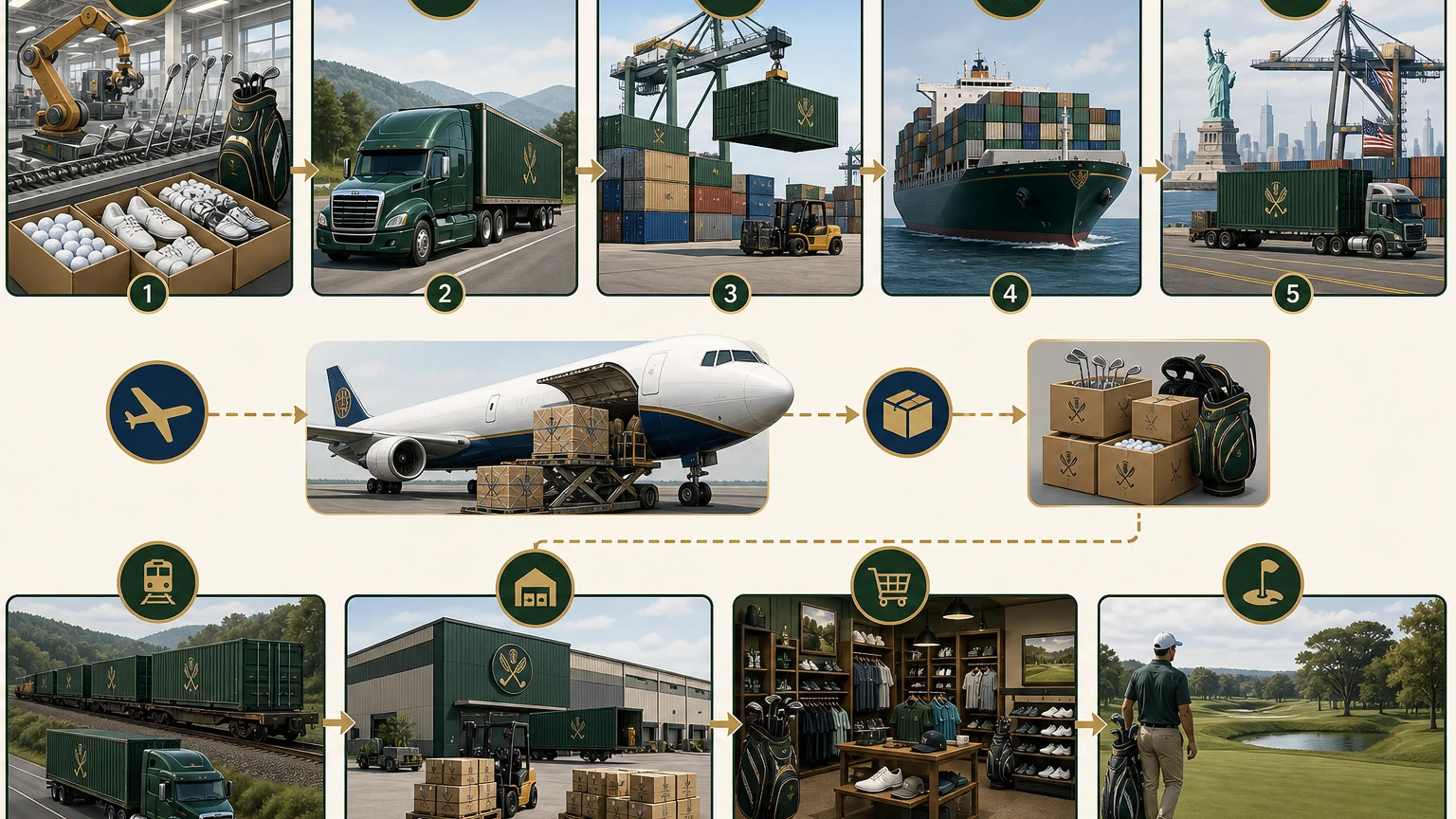
A common imported golf-equipment journey might look like this:
A manufacturer produces golf clubs in Vietnam.
The finished products are boxed and loaded into a container.
A truck moves the container to the export port.
A container ship transports the equipment across the Pacific.
The container arrives at a U.S. port.
A drayage truck moves it to a rail terminal.
A train carries the container inland.
Another truck transports it to the golf company's distribution center.
Warehouse workers receive the inventory and divide it into customer orders.
A full truckload or LTL carrier delivers inventory to a sporting-goods retailer.
A golfer purchases the club.
For an online order, the final steps may be different:
The club leaves the distribution center through a parcel network and arrives at the customer's home by delivery van.
The golfer may see only one cardboard box.
Behind that box can be a logistics chain covering thousands of miles and several modes of transportation.
Frequently Asked Questions
Where Is Most Golf Equipment Made?
There is no single manufacturing country. Major golf supply chains involve countries including the United States, Mexico, China, Taiwan, Vietnam, Thailand, Japan, South Korea, and others. The exact location depends on whether the product is a club, ball, shoe, bag, glove, apparel item, or accessory.
Are Golf Clubs Made in China?
Many golf clubs or club components are manufactured in China, but China is only one part of the industry's manufacturing network. Vietnam and Taiwan are also important club-production centers, while final assembly can occur in places including Mexico and the United States.
Are Golf Clubs Made in the USA?
Some golf equipment manufacturing and assembly takes place in the United States, particularly custom club assembly and specialized production. However, many components used in modern golf clubs come from international suppliers.
Where Are Titleist Golf Balls Made?
Titleist has manufactured Pro V1 and Pro V1x golf balls at facilities in Massachusetts and Thailand.
Where Are Callaway Golf Clubs Assembled?
Callaway reports a primary golf club assembly operation in Monterrey, Mexico, a smaller assembly facility in Carlsbad, California, and contract manufacturing relationships in Vietnam and China.
Where Are Golf Shoes Made?
Golf footwear is heavily connected to Asian manufacturing. Vietnam is particularly important; Acushnet currently uses a major third-party Vietnam facility for FootJoy footwear production.
How Is Golf Equipment Shipped From Asia to the USA?
Large commercial shipments are commonly transported by truck from the factory to a port and then loaded into shipping containers for ocean transportation. After arriving in the United States, containers can move by truck or rail to distribution centers.
Is Golf Equipment Transported by Air?
Yes, but air freight is normally more expensive than ocean shipping. It is most useful for urgent inventory, samples, high-value goods, product launches, or situations where the cost of waiting is greater than the additional transportation expense.
Are Golf Clubs Transported in Refrigerated Trailers?
Normally no. Golf clubs and most other golf equipment do not require temperature-controlled transportation and can typically travel in ordinary dry containers, dry vans, LTL trailers, and parcel networks.
Do Semi-Trucks Transport Golf Equipment?
Yes. Trucks are involved throughout the supply chain. They can move containers from ports, transport inventory between distribution centers, deliver truckload and LTL shipments to retailers, and connect factories with ports and rail terminals.
Final Thoughts
Golf equipment is far more international than many players realize.
A club carrying an American brand name may use components manufactured in Taiwan or Vietnam and be assembled in Mexico. A premium golf ball may come from Massachusetts or Thailand. Golf shoes may be manufactured in Vietnam, while some premium clubs and components maintain strong manufacturing links to Japan.
Major golf companies therefore depend on a network of factories and suppliers spread across North America, Asia, and Europe.
Transportation connects that network.
Ocean container ships move large volumes of equipment between continents. Trucks connect factories with ports and distribution centers. Rail carries imported containers across long distances inside the United States. Air freight handles urgent shipments, while LTL and parcel carriers take smaller orders to retailers, golf courses, and individual players.
For golf equipment entering the American market, the complete journey may look like:
Factory → Truck → Port → Container Ship → U.S. Port → Rail or Truck → Distribution Center → Retailer or Golf Course → Golfer
Products assembled in Mexico or manufactured in the United States can follow shorter routes, but they still depend heavily on trucking and warehousing.
So when a golfer walks into a store and buys a new driver, golf bag, pair of shoes, or box of balls, they are purchasing the final result of much more than product design and manufacturing.
Behind almost every piece of modern golf equipment is a global logistics network involving factories, ports, ships, trains, warehouses, semi-trucks, and delivery vehicles working together to get the product onto the golf course.