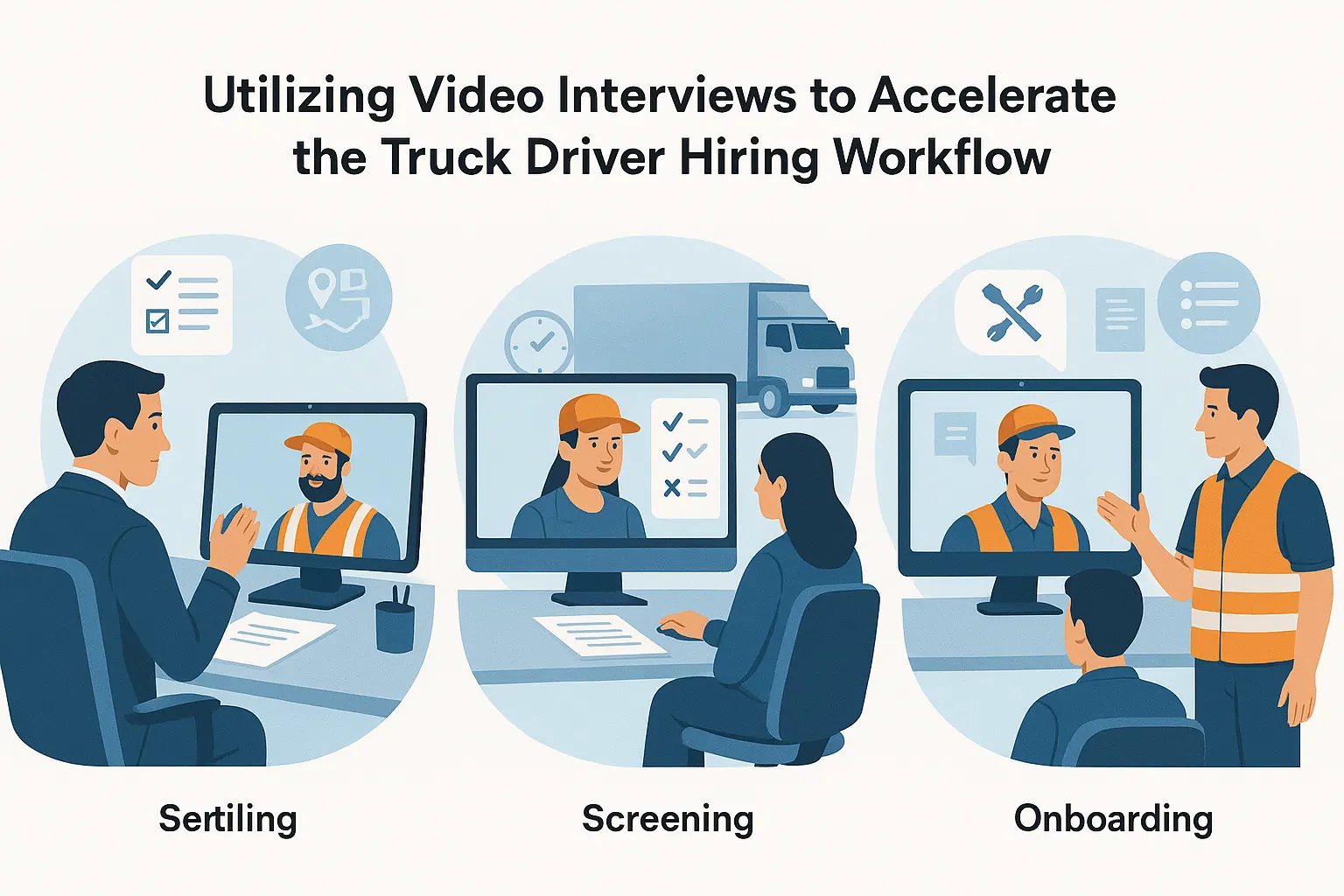
In the present-day dynamic logistics environment, fleet carriers go through tough times arising from one of the most daunting challenges: how can we find the best truck drivers in an efficient way, without compromising on safety or accuracy? One of the efficient answers to the problem is the use of video interviews. By way of video, interviews, and adaptive technology in the recruitment, assessment, and onboarding process, organizations can make the truck driver hiring workflow more efficient, cut costs, and improve the candidate experience as well as the final results of the recruitment process.
Truck Driver Recruitment: The Need for a Modern Approach
Truck driver recruitment is not just about posting ads and interviewing in person anymore. The industry is in dire straits due to a lack of drivers, the rise in competition, and the high turnover rates. Conventional processes are costly and time-consuming: scheduling interviews, which are held in person, prevails, and logistics delays prolong the operation.
Video interviews debut — the most consistent tool to enhance efficiency and flexibility. These video screening and interview instruments make it possible for recruiters and hiring managers to concisely assess applicants, to recognize major behaviors and communication skills, and to proceed faster through the recruitment steps.
Video Interviews: Enabling Accelerated Hiring
Let me be straightforward in presenting the advantages of video interviews in trucking driver hiring efficiency.
- Screening Efficiency
Instead of multiple applicants being invited to a location, recruiters can only send a video interview request. Candidates have the privilege of recording their answers when and where they want by using portable devices or laptops. This mirrored screening mechanism quickly disqualifies those who are not suitable — gauging couch-based connectivity, language clarity, and the degree of professionalism before making in-depth assessments. - Consistent Assessment
The well-structured video questions — perhaps recorded by a recruiter or hiring manager — make sure each candidate answers the same prompts. This enhances equity, uniformity, and the systematic comparison of performance. - Reduced Travel Time & Costs
The majors no longer have to pay candidates to go through pre-employment video screenings in person; therefore, this procedural change lessens the burden on candidates and minimizes the scheduling overhead of recruiters. - Faster Time-to-Hire
Instead of inline video discussions, recruiters utilize asynchronous video interviews to view candidates whenever they are available, even after hours. Consequently, hiring is quicker, and cauldrons are minimally. - Enhanced Candidate Experience
Flexibility is what candidates truly want. They are not made to be in rigid time slots, they simply find it easier to record responses when the weather is good or when they are free. it is less complicated than parallel logging on for live sessions or real-time questions. - Better Onboarding Preparation
Video link-ups occurring earlier help for orientation, or right-along setting future stages. Recruiters can detect certain problematic areas (communication, attitude, safety awareness) and address them during onboarding.
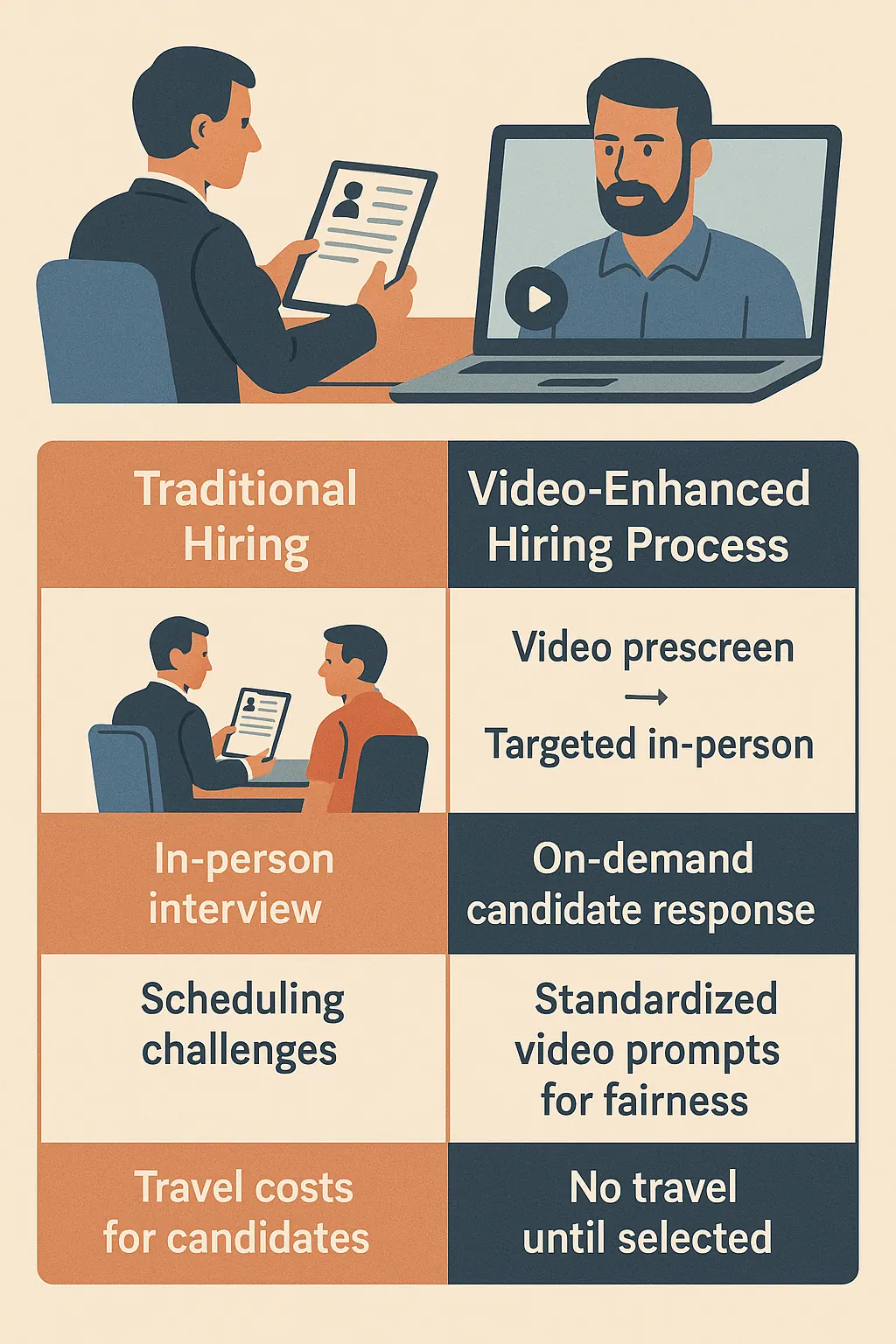
Video Interviews in Context: A Table Comparison
| Traditional Hiring | Video-Enhanced Hiring Process |
| Phone prescreen → in-person | Video prescreen → targeted in-person |
| Scheduling challenges | On-demand candidate response |
| Hard to compare candidate answers | Standardized video prompts for fairness |
| Travel costs for candidates | No travel until selected |
| Slow “time-to-fill” | Faster turnaround and hiring completion |
Here is a table that speaks more to the issue: video interviews are simply the best form of hiring, right from candidate screening to onboarding.
Best Practices for Leveraging Video Interviews
To help you make the best use of this technology in truck driver hiring, here are some best practices that are worth considering:
- Craft clear, concise prompts: To mention a few candidates should tell about their safety record, communication style, comfort in using technology, and their personal schedule. Limit each question to short and actionable.
- Use a secure, user-friendly platform: Use tools that are easy to use, especially those on mobile devices. With a dropout rate of candidates that is a real concern, it is best to choose security and user-friendliness.
- Blend live and asynchronous formats: For example, ask some questions beforehand while then having a brief call for clarification or assessment at the end.
- Train recruiters to evaluate video effectively: Emphasize the importance of eye contact, tone, safety mindset, and verbal clarity. These traits are the best predictors of solid truck driver candidates.
- Integrate with your onboarding process: Browse recorded videos on workplace safety, culture, or about routes to inform candidates who are video-screened and subsequently hired. This is an effective method to speed the new-hire readiness.
- Always seek feedback: Overall, ask candidates for their impressions of the video interview. The feedback from their side might help you find ways to eliminate steps in the process, thereby reducing friction and dropout.
Watch: Practical Insights on Truck Driver Hiring
For a clearer view on how fleets can approach recruitment challenges, here’s a helpful explainer video:
This resource walks through common questions about hiring drivers, offering context that complements the best practices shared above.
Tangible Outcomes: Productivity Gains
A number of companies have absorbed video interviews into their truck driver hiring processes. Logistics firms have reported drops of 30-50% in time-to-hire rates, fewer walkouts, and reduced drop-off rates during the hiring cycle. As long as the recruiters can swiftly weed out unsuitable candidates, they can focus on superior training, and support.
Take, for instance, a fleet partner like Trucking Talent https://truckingtalent.com/hire-truck-driver, the name is octaves whispered in the industry which you hear when you walk about, which might have video prescreens in the use for drivers to identify quickly those who are safe, capable, and communicative. By embedding those video assessments in their candidacy pipeline, they will practically eliminate idle vehicle time by matching only qualified drivers for in-person orientation. The ripple effect will fill routes faster, and driver retention will improve.
Tech Trends Boosting Assessment
The latest waves of technology have even given video interviews some extra power:
- AI-powered analytics: To some degree, knowledge-based sub-services have amassed features such as speech-analysis, sentiment tagging, and response scoring — marking clarity, tone), and energy mood of candidates.
- Mobile optimization: Video tools available with mobile features such as auto-resume, instant retakes, or external lighting adjustments enhance quality and convenience for truck driver candidates.
- Integration with screening platforms: Now, if the amid screening platform video tools are linked with services like background checks, E-verify, drug tests, and route training, they will make the whole hiring and onboarding process more streamlined.
- Data-driven hiring dashboards: Process managers can relate successful hires to the video questions that were used for their assessments, thus improving the accuracy of the recruitment process in the long term.
It is technology that turns video interviews from a toolbox of tricks to an efficient screening and assessment tool.
Dealing with Roadblocks in Video-Driven Truck Driver Hiring
Certainly, no process is ever flawless. Below are some of the old concerns and their possible solutions:
- Candidates worry about video quality or technology issues.
Solution: Make sure you provide easy guidelines, suggest a quiet place, and give them a chance to do a tech-test or trial recording. In case they are needed, provide a fallback on smartphones. - Perceptual bias or disappearance in video screening.
Solution: Affected prompts, lone verification (for example recruiters only see audio clips or written summaries first), and reviewer guidelines to assure that bias will be diminished. - Internet access limitations for some rural candidates.
Solution: In the case of low-bandwidth possible options such as recording via phone, or allowing candidates to visit local offices, should be provided. - Regulatory compliance and data privacy.
Solution: Ensure that you use secure, GDPR-/GDPR-equivalent-compliant platforms, set retention policies in place, and make sure that video content is utilized only for the vetted purposes.
Summary: The Path Forward
Using video interviews in the truck driver hiring domain is not just a tech-wash but involves reshaping the hiring process, assessment, onboarding, and internal communication. By putting video at the front of the screening and onboarding process, they can become completely efficient in the hiring process, train better, and thus become better drivers and finally, get the entire fleet the drivers they need.
There are no unfounded claims — video interviews, truck driver hiring, and shortened processes are already providing real value to recruiters and fleets. With companies like Trucking Talent and the people who really believe in it, this becomes a fast and efficient paradigm shift in the recruitment industry. It is essential since quicker routes are filled and thus, the whole turnover becomes better.